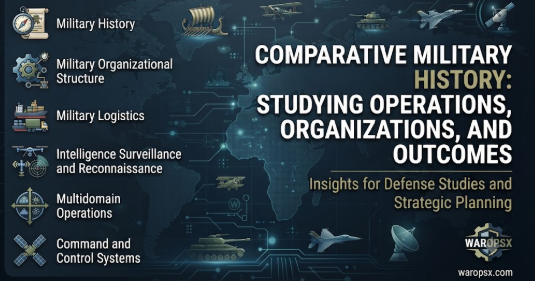
Comparative Military History: Studying Operations, Organizations, and Outcomes

September 16, 2026 · 15 reads
Introduction
Understanding how defense systems work goes far beyond memorizing equipment or battle dates. It requires a clear look at how high-level plans connect with daily logistics, technology, leadership, and organization. WarOpsX provides a dedicated educational space for students, researchers, and curious readers to explore these interconnected subjects. By breaking down foundational topics like military strategy, defense studies, and operational coordination, learners can build a solid, practical understanding of how complex defense environments operate.
What Is WarOpsX?
WarOpsX is an educational platform dedicated to exploring military strategy, defense studies, operational concepts, and the evolution of modern defense environments. Rather than focusing on tactical combat or promotional marketing, the platform provides structured educational resources for understanding how strategic objectives, leadership, technology, and organizational readiness connect within complex systems.
The website is built for students, researchers, policy learners, and professionals who want to understand the foundational principles governing defense organizations. Through clear explanations and high-level overviews, WarOpsX helps readers make sense of complex topics without requiring specialized prior knowledge.
Why Is WarOpsX Relevant for Defense and Military Education?
Understanding defense and military concepts is essential for anyone studying international relations, history, policy, or organizational management. Defense environments are rarely shaped by a single factor; instead, they rely on a delicate balance between strategy, operations, logistics, information management, and technological readiness.
Resources that connect these disparate subjects help learners see the bigger picture. By studying how logistics support operations, how command structures guide decision-making, and how historical precedents influence modern systems, readers gain a comprehensive understanding of defense mechanics. WarOpsX provides a centralized educational space to explore these relationships in a structured and accessible manner.
Military Strategy
Military strategy forms the bedrock of how defense organizations plan and execute their long-term objectives. At its core, strategy involves aligning available resources with desired political or security goals.
- Strategic Objectives: Establishing clear, achievable goals that guide overall planning.
- Resource Allocation: Balancing personnel, equipment, and financial means to support overarching aims.
- Relationship with Operations: Translating broad strategic intent into actionable operational plans.
- Role of Leadership: Guiding institutional vision and adapting to changing security environments.
Studying strategy helps learners understand why organizations make specific choices and how long-term planning shapes institutional outcomes.
Defense Studies
Defense studies is a multidisciplinary academic field that looks beyond hardware and combat to examine the broader context of national and international security. It incorporates political science, history, economics, and sociology to analyze how defense organizations operate within society.
- Strategic Analysis: Assessing security threats, policies, and deterrence models.
- Institutional Frameworks: Examining how governments and military branches govern themselves.
- Technology and Policy: Understanding the intersection of emerging innovations and security policy.
- Research and Education: Fostering critical thinking about global security challenges.
This field provides the analytical tools needed to evaluate defense issues objectively and comprehensively.
Military Operations
Military operations bridge the gap between high-level strategy and ground-level execution. This area focuses on how plans are coordinated, synchronized, and sustained across various environments.
- Operational Planning: Designing structured campaigns to achieve specific strategic goals.
- Coordination and Synchronization: Ensuring different units work together efficiently.
- Decision-Making Processes: Gathering information and making timely choices under pressure.
- Levels of War: Distinguishing between strategic, operational, and tactical responsibilities.
Understanding operations allows learners to appreciate the immense coordination required to execute large-scale plans successfully.
Military Logistics
Logistics is often called the backbone of any defense organization. Without effective supply chains and sustainment systems, even the best strategies and operations fail.
- Supply Chain Management: Procuring, storing, and distributing food, fuel, spare parts, and equipment.
- Transportation Networks: Moving personnel and assets via land, sea, and air.
- Maintenance and Repair: Keeping equipment operational and reliable over time.
- Sustainment and Readiness: Ensuring long-term operational endurance and force availability.
Studying logistics reveals the immense operational weight required to maintain military capability.
Command and Control Systems
Command and control (C2) refers to the exercise of authority and direction by a designated leader over assigned forces. Effective C2 ensures that organizational goals are communicated clearly and executed efficiently.
- Leadership and Communication: Transmitting intent and orders clearly through the chain of command.
- Information Management: Collecting, processing, and disseminating relevant data to decision-makers.
- Situational Awareness: Maintaining a clear, shared understanding of the operational environment.
- Organizational Structure: Establishing clear lines of authority and responsibility.
Command and control systems connect people, information, and technology to enable coordinated action.
Defense Technology
Technology continuously reshapes how defense organizations operate, communicate, and gather information. Exploring defense technology involves understanding the tools and systems that enhance modern capabilities.
- Artificial Intelligence: Supporting data analysis, planning, and automated system management.
- Autonomous Systems: Utilizing uncrewed vehicles for dull, dirty, or dangerous tasks.
- Sensors and Communications: Enhancing data collection and secure information sharing.
- Cyber Capabilities: Protecting digital infrastructure and managing information security.
Technology serves as an enabler, heavily influencing how decisions are made and how organizations maintain readiness.
Military History
History offers a vast laboratory of past successes, failures, and institutional adaptations. Studying military history helps learners understand how modern defense systems evolved.
- Evolution of Tactics and Strategy: Observing how concepts changed in response to new challenges.
- Technological Adoption: Examining how past organizations integrated new inventions.
- Leadership Lessons: Analyzing decision-making under historical constraints.
- Institutional Change: Understanding how large military organizations reform over time.
Historical study prevents learners from viewing modern developments in a vacuum.
Military Organizational Structure
Military organizations require clear hierarchies and organizational models to function effectively. Structure dictates how authority flows, how responsibilities are divided, and how units coordinate.
- Hierarchy and Rank: Establishing clear lines of command and accountability.
- Unit Specialization: Organizing personnel into specialized branches, corps, and divisions.
- Joint Organizations: Integrating multiple service branches into unified commands.
- Command Relationships: Clarifying operational control and administrative responsibilities.
A well-defined structure is essential for maintaining order and efficiency within large institutions.
Multidomain Operations
Modern defense environments require organizations to operate across multiple domains simultaneously. Multidomain operations explore how different physical and virtual realms interact.
- Land and Maritime Domains: Traditional environments focused on surface movement and control.
- Air and Space Domains: Operating in the skies and orbital pathways for observation and communication.
- Cyber and Information Domains: Managing digital networks, electronic signals, and public information environments.
- Cross-Domain Synergy: Coordinating activities across all domains to achieve mutual support.
Understanding multidomain concepts helps readers grasp the complexity of contemporary security environments.
Intelligence Surveillance and Reconnaissance
Intelligence, Surveillance, and Reconnaissance (ISR) systems provide the information foundation necessary for informed decision-making.
- Information Collection: Gathering raw data through sensors, reconnaissance, and human reporting.
- Analysis and Processing: Converting raw data into actionable intelligence.
- Monitoring and Awareness: Keeping watch over potential areas of interest.
- Decision Support: Providing leaders with accurate, timely insights to guide strategy and operations.
ISR ensures that organizations act based on facts rather than assumptions.
How These Defense Areas Connect
To truly understand defense systems, one must recognize that these subjects do not exist in isolation. Military strategy sets the overarching vision, which is then translated into military operations. These operations cannot succeed without robust military logistics to supply and sustain forces.
Throughout this process, command and control systems facilitate decision-making, supported by intelligence surveillance and reconnaissance data. Defense technology enhances these systems, while military organizational structure provides the framework for people to work together. Finally, studying military history provides the context needed to see how these elements have evolved and interacted over decades.
Key Elements Covered by WarOpsX
| Subject Area | What It Covers | Why It Matters | Related Areas |
| Military Strategy | Objectives, planning, and resource allocation | Defines the ultimate purpose and direction of defense efforts | Defense Studies, Military History |
| Military Operations | Campaign planning, coordination, and execution | Bridges strategy with ground-level reality | Command and Control, Logistics |
| Military Logistics | Supply chains, transportation, and sustainment | Ensures long-term operational endurance and readiness | Organizational Structure, Technology |
| Command and Control | Leadership, communication, and information flow | Enables coordinated decision-making and situational awareness | Operations, ISR |
| Defense Technology | AI, autonomous systems, sensors, and cyber tools | Influences modern capability, communication, and efficiency | Multidomain Operations, ISR |
Benefits of Learning These Defense Concepts
Exploring military and defense concepts offers several distinct educational advantages:
- Improved Terminology Understanding: Demystifies complex defense vocabulary and acronyms.
- Enhanced Historical Literacy: Connects past military campaigns to modern strategic thinking.
- Better Policy Comprehension: Provides a framework for evaluating national security and defense policies.
- Systemic Thinking: Teaches learners to view organizations as interconnected systems rather than isolated units.
Step-by-Step Approach to Studying Military and Defense Systems
Step 1: Start With Basic Terminology
Begin by learning common defense terms, acronyms, and foundational concepts to build a comfortable reading vocabulary.
Step 2: Understand Military Strategy
Explore how political and security objectives translate into long-term strategic plans and resource management.
Step 3: Study Military Operations
Examine how strategic ideas are structured into operational plans, coordination frameworks, and multi-unit campaigns.
Step 4: Learn About Military Organizational Structure
Study the hierarchies, ranks, and joint command relationships that give military organizations their shape.
Step 5: Understand Military Logistics
Investigate supply chains, maintenance schedules, and transportation networks that keep forces supplied and sustained.
Step 6: Study Information and Command Systems
Look at how leadership, communication, and decision-making processes function under pressure.
Step 7: Examine Technology and Multidomain Environments
Explore how modern technologies and interactions across land, sea, air, space, and cyber domains influence defense systems.
Step 8: Use Military History to Connect the Concepts
Review historical examples to see how strategy, logistics, and technology have evolved and shaped modern defense institutions.
Common Mistakes When Studying Military and Defense Topics
- Studying Technology in Isolation: Focusing solely on weapons or software without understanding the strategy or logistics required to support them.
- Ignoring Logistics: Overlooking the vital role of supply chains, maintenance, and sustainment in military success.
- Treating History as a List of Battles: Memorizing dates and names without analyzing the underlying institutional or strategic causes.
- Confusing Strategy and Tactics: Mixing up broad, long-term goals with immediate, localized execution.
- Treating Domains Separately: Assuming land, sea, air, space, and cyber environments operate independently of one another.
Practical Tips for Students and Researchers
- Read introductory texts on military history and defense policy before diving into specialized technical manuals.
- Take notes on how logistics and command structures influence operational outcomes in historical case studies.
- Compare traditional defense models with modern multidomain concepts to observe institutional evolution.
- Follow reputable academic and educational resources, such as WarOpsX, to explore structured explanations of defense topics.
Who Can Benefit From WarOpsX’s Educational Content?
Students
Students pursuing history, political science, or international relations can use structured educational resources to grasp fundamental defense concepts.
Researchers
Researchers looking for clear overviews of military strategy, organizational structures, and logistics can find reliable baseline information.
Defense Studies Learners
Individuals expanding their knowledge in defense studies can explore interconnected topics like command systems and multidomain operations.
Policy Learners
Policy learners can gain a clearer understanding of how strategic planning, technology, and organizational readiness inform security discussions.
Defense Technology Professionals
Professionals working in tech sectors can better understand the broader defense environment and how their innovations fit into larger operational systems.
Defense Enthusiasts and General Readers
General readers with a passion for military history and strategy can satisfy their curiosity through clear, accessible educational guides.
Traditional vs. Modern Defense Concepts
| Defense Concept | Traditional Understanding | Modern Development | Key Learning Point |
| Command and Control | Linear communication via radio and physical dispatch | Digitized networks, real-time data sharing, and AI support | Information speed and situational awareness have dramatically increased. |
| Military Logistics | Local stockpiles and basic ground transportation | Global supply chains, predictive maintenance, and automated tracking | Sustainment relies heavily on complex, interconnected global networks. |
| Operational Environment | Primarily separate land, sea, and air domains | Highly integrated multidomain operations spanning space and cyber | Success requires seamless coordination across all operational realms. |
Real-World and Historical Context
History shows that organizations failing to adapt their logistics or command structures often struggle during periods of rapid change. For instance, the expansion of railway networks in the nineteenth century fundamentally transformed military logistics, allowing armies to move and be sustained at unprecedented scales. Similarly, the introduction of radio communication in the early twentieth century revolutionized command and control, enabling leaders to coordinate dispersed units in real time. Studying these historical shifts helps clarify why modern defense organizations continue to adapt their technologies and organizational structures today.
Modern Developments
Contemporary defense environments continue to evolve with the introduction of advanced data analytics, autonomous systems, and cyber capabilities. Rather than replacing traditional principles of strategy and logistics, these technologies interact with them. Artificial intelligence assists analysts in processing vast amounts of ISR data, while cyber capabilities introduce new dimensions to information management and infrastructure protection. Understanding these modern developments requires looking at how they integrate into existing organizational and command frameworks.
Frequently Asked Questions
What does WarOpsX focus on educationally?
WarOpsX focuses on explaining military strategy, defense studies, logistics, command systems, technology, and organizational structures through clear, accessible educational resources.
Why is military strategy important to study?
Military strategy matters because it defines how organizations align their resources and actions with overarching political and security objectives.
How do military operations relate to strategy?
Operations translate broad strategic intent into structured, actionable campaigns and coordinated activities on the ground, at sea, or in the air.
What is the role of military logistics?
Logistics encompasses supply chains, transportation, and maintenance, ensuring that defense organizations remain sustained and ready for action.
What are command and control systems?
Command and control systems involve leadership, communication, and information management, enabling leaders to direct forces and maintain situational awareness.
How does defense technology impact organizations?
Technology influences decision-making, communication speed, and operational efficiency through tools like sensors, AI, and cyber capabilities.
Why is military history relevant today?
Military history provides valuable context on how organizations, strategies, and technologies have evolved, helping learners avoid past mistakes.
What is meant by multidomain operations?
Multidomain operations refer to the coordination of activities across land, maritime, air, space, cyber, and information environments.
What does ISR stand for in defense studies?
ISR stands for Intelligence, Surveillance, and Reconnaissance, representing the systems used to collect information and support decision-making.
Who is the target audience for WarOpsX?
The platform is designed for students, researchers, policy learners, and defense enthusiasts seeking structured educational insights into military systems.
Conclusion
Examining the mechanics of defense and military systems highlights how many different moving parts must work together. From foundational strategy and operational planning to logistics, command structures, and modern technology, no single element stands alone. Platforms like WarOpsX offer a clear, structured way to explore these concepts without unnecessary complexity or confusion. By studying how history, organization, and strategy connect, readers gain a deeper, well-rounded appreciation of how defense institutions function in an ever-changing world.
Leave a Reply