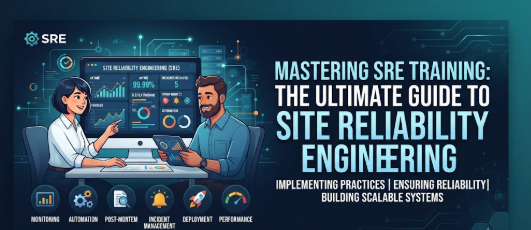
Mastering SRE Training: The Ultimate Guide to Site Reliability Engineering

September 19, 2026 · 32 reads
Introduction
Modern software systems run around the clock. When a popular streaming service, banking app, or online store crashes, millions of users are affected instantly. Keeping these complex digital platforms running smoothly requires specialized skills.
In the past, developers wrote code and handed it over to operations teams to run. This created friction when things broke. Site Reliability Engineering emerged to solve this problem by applying software engineering principles to infrastructure and operations.
However, mastering reliability concepts can feel overwhelming for beginners due to the heavy reliance on distributed systems, cloud tools, and automation frameworks. Without a clear path, engineers often struggle to understand where to start.
This guide explains what site reliability engineering is, how structured training programs work, what core concepts you need to know, and how to build a lasting career in the field.
What Is Site Reliability Engineering?
Site Reliability Engineering is a discipline that incorporates software engineering and applies it to infrastructure and operations problems. The goal is to create ultra-scalable and highly reliable software systems.
Originally popularized by companies like Google, SRE treats operations as a software problem. Instead of manual troubleshooting, engineers write automation code to manage systems, handle failures, and scale applications.
Why It Matters
Traditional IT operations rely heavily on manual tasks and firefighting. When an outage occurs, engineers scramble to fix symptoms rather than root causes. SRE shifts this mindset toward proactive engineering, measuring system reliability, and reducing manual toil through automation.
How SRE Works in Practice
An SRE team focuses on measuring and improving system uptime, performance, and capacity. They use specific metrics and feedback loops to understand how systems behave in production.
Key Operational Pillars
- Service Level Indicators (SLIs): Quantitative measures of service performance, such as request latency or error rates.
- Service Level Objectives (SLOs): Target values for reliability set by the SLIs, agreed upon by the team and business stakeholders.
- Service Level Agreements (SLAs): Business contracts with customers regarding service availability, often tied to financial penalties if breached.
- Error Budgets: The allowance for how much unreliability a service can experience before users are negatively impacted. If the error budget is healthy, developers can release new features quickly. If it is depleted, focus shifts entirely to stability.
Why SRE Training Matters
Transitioning into a reliability role requires practical knowledge that goes beyond basic coding or standard system administration. Structured SRE training helps bridge this knowledge gap.
The Problem With Self-Taught Learning
Many beginners try to learn tools like Kubernetes, Terraform, and Prometheus individually without understanding how they fit together in a production pipeline. This leads to fragmented knowledge and difficulty troubleshooting complex outages.
What Structured SRE Training Provides
A well-designed SRE course or training program provides a guided learning path. It moves from foundational concepts to advanced production practices, teaching you how to design resilient architectures, handle incident response, and implement continuous delivery safely.
SRE Certification and Validation
As organizations demand higher system uptime, certifications have become a popular way for engineers to prove their operational competence.
What an SRE Certification Covers
Comprehensive certification programs validate your knowledge across several domains:
- Cloud infrastructure and distributed systems
- Monitoring, logging, and observability frameworks
- Incident management and post-mortem analysis
- Infrastructure as Code (IaC) and automation
- Capacity planning and performance tuning
Benefits of Getting Certified
- Structured Learning: Forces you to study core concepts systematically rather than skipping difficult topics.
- Career Credibility: Signals to employers that you possess verified skills in managing production-grade systems.
- Confidence: Prepares you to handle high-pressure operational scenarios in real-world environments.
Essential SRE Tools and Technologies
An SRE engineer relies on a diverse toolchain to maintain system visibility and automation.
| Category | Common Tools | Purpose |
| Observability | Prometheus, Grafana, Datadog | Monitoring metrics, collecting logs, and visualizing system health. |
| Infrastructure as Code | Terraform, Ansible | Automating infrastructure provisioning and configuration management. |
| Container Orchestration | Kubernetes, Docker | Managing scalable containerized applications across clusters. |
| Incident Management | PagerDuty, Opsgenie | Managing alerts, on-call schedules, and incident response workflows. |
SRE Best Practices for Reducing Failures
Implementing proven best practices helps teams catch problems early and minimize downtime.
- Embrace Blameless Post-Mortems: When an incident happens, focus on fixing the broken process or system vulnerability rather than blaming individuals.
- Automate Repetitive Toil: If an engineer has to perform a manual, repetitive task more than twice, write a script or automation tool to handle it.
- Test for Failure: Use chaos engineering practices to intentionally inject failures into staging or production environments to test system resilience.
- Gradual Rollouts: Use canary deployments and blue-green deployments to release code changes to a small subset of users before hitting the entire user base.
Common Mistakes Beginners Make
1. Focusing Only on Tools Instead of Principles
- What people do: Learn how to configure a specific monitoring tool without understanding what metrics actually matter.
- Why it causes problems: Tools change frequently, but core engineering principles like latency tracking, redundancy, and capacity planning remain constant.
- What to do instead: Master the underlying reliability concepts first, then apply tools to implement them.
2. Ignoring Developer Workflow
- What people do: Act as gatekeepers who block software releases in the name of stability.
- Why it causes problems: Creates friction between development and operations teams, slowing down business innovation.
- What to do instead: Collaborate with developers early in the software lifecycle to build reliable systems together.
Decision-Making Framework for Adopting SRE
If your organization or team is considering moving toward SRE practices, follow this step-by-step approach:
- Assess Current Pain Points: Identify where your systems experience the most downtime or where engineers spend the most time on manual tasks.
- Define Initial SLIs and SLOs: Pick two or three critical user journeys (such as user login or checkout) and define simple performance targets.
- Introduce Automation Gradually: Automate the most repetitive operational tasks first to free up engineering time.
- Establish Incident Response Standards: Set up clear on-call rotations, alerting thresholds, and structured post-mortem reviews.
- Review and Iterate: Regularly analyze your error budgets and adjust your engineering priorities based on real-world reliability data.
Checklist for SRE Implementation
Use this practical checklist to verify that your systems are ready for production reliability standards:
- Critical user journeys have clearly defined SLIs and SLOs.
- Error budgets are established and shared between development and operations teams.
- Comprehensive monitoring and alerting are active for all core services.
- Infrastructure is managed using code rather than manual server configuration.
- Incident response playbooks are documented and accessible to the on-call team.
- Blameless post-mortem processes are in place to review past outages.
Key Terms
- Toil: Repetitive, manual operational work that lacks enduring value and scales linearly as service growth increases.
- Observability: The ability to measure the internal state of a system by examining its outputs, such as logs, metrics, and traces.
- Chaos Engineering: The discipline of experimenting on a system in production to build confidence in the system’s capability to withstand turbulent conditions.
- Canary Deployment: A technique where a new software version is rolled out to a small fraction of users to test for bugs before a full release.
- Post-Mortem: A structured analysis and written record of an incident, its root cause, and steps taken to prevent recurrence.
FAQs
What is the difference between DevOps and SRE?
DevOps is a cultural and professional movement focused on collaboration between development and operations to deliver software faster. SRE is a specific implementation of that philosophy, treating operations as a software engineering problem with a heavy focus on reliability, measurement, and automation.
Do I need to know how to code to become an SRE?
Yes. Because SRE applies software engineering to operations, you need programming skills—typically in languages like Python, Go, or Bash—to write automation scripts, build tools, and manage infrastructure.
How long does it take to complete an SRE course?
The duration depends on your background and the depth of the program. Foundational courses may take a few weeks, while comprehensive SRE training paths covering advanced Kubernetes, observability, and cloud automation often span several months.
Is SRE training suitable for beginners?
Yes, provided the training starts with fundamentals like Linux, networking, and cloud basics before moving into advanced reliability engineering practices.
What cloud platforms are commonly used in SRE?
SRE practices apply across all major cloud providers, including Amazon Web Services (AWS), Google Cloud Platform (GCP), and Microsoft Azure, as well as on-premise Kubernetes environments.
Conclusion
Site Reliability Engineering is essential for building dependable modern technology platforms. By mastering core concepts like SLOs, error budgets, observability, and automation, engineers can transform fragile systems into resilient architectures.
Whether you are starting with an introductory SRE tutorial or pursuing structured training, focusing on practical fundamentals will help you build a rewarding career as a site reliability engineer.
Leave a Reply