A Traveller’s Checklist for Renting Motorcycles, Scooters and Cars in Colombia With Local Providers on MotoShare

October 15, 2026 · 2 reads
Introduction
A good rental begins with a short list of questions. Where am I going? How far will I travel each day? Who is coming with me, and how much luggage do we have? Which vehicle suits my skill? What will the rental really cost, and what do the terms say? Travellers who answer these in advance usually have a smoother trip than those who decide in a hurry.
Colombia is a country where the answers vary. City traffic, mountain roads, and warm coastal towns each place different demands on a vehicle and its driver. Public transport covers some journeys, but it follows fixed routes and timetables. A rented motorcycle, scooter, or car gives you control over when to leave and where to stop, which helps on holidays, business trips, and longer journeys.
This article works through those questions one by one. It describes the vehicle types, the details inside a rental agreement, and the preparation that supports a safe trip. Most sections end with a brief checklist you can carry into your own planning. It also explains how MotoShare, an online rental marketplace, can support the early comparison stage.
How the MotoShare Marketplace Works for Renters
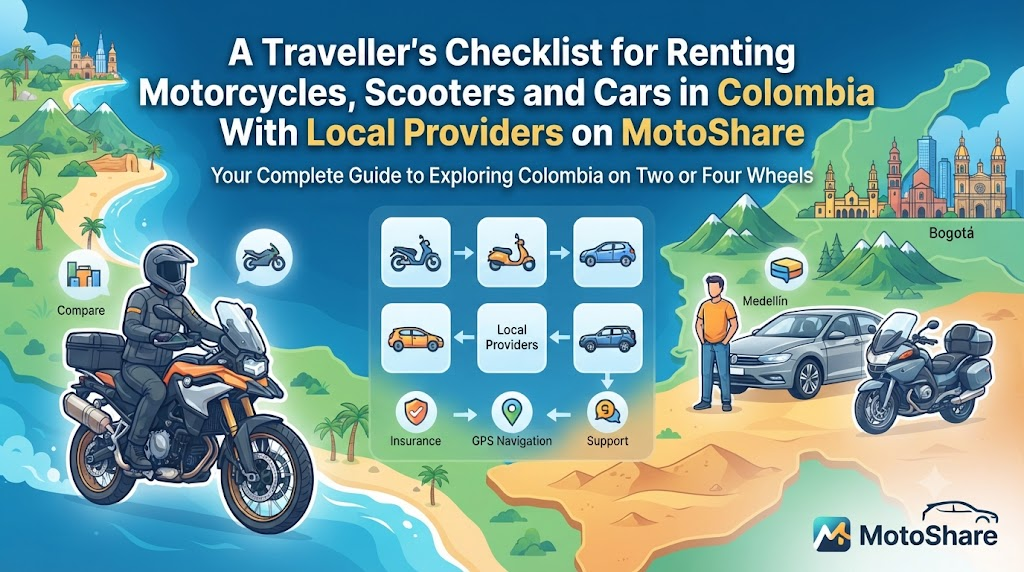
MotoShare is a Colombia-focused online vehicle-rental marketplace. It does not run a single fleet of its own. Its role is to connect renters with local providers, and its listings include motorcycles, scooters, and cars such as hatchbacks, sedans, and SUVs.
Its audience is wide. International tourists, local travellers, commuters, backpackers, and adventure riders can all use it, whether they need a vehicle for a weekend or a longer stay. For many visitors, the first search is motorcycle rental Colombia, followed by a look at other vehicle types as the plan develops.
A marketplace involves three different actions:
- Searching means entering a place and rental dates to see what is available.
- Comparing means studying vehicle types, prices, and provider terms side by side.
- Confirming means choosing one listing and completing the booking.
Comparison is the stage that deserves the most attention. Two reminders apply throughout this article. Availability depends on the city and the date, and conditions depend on the provider, so each listing should be read on its own.
Reasons Behind Each Rental Choice
People rent vehicles for very different reasons.
A tourist who wants to explore a destination freely may enjoy a motorcycle, which can reach places where parking is difficult. A commuter who needs temporary daily transport may prefer something small, economical, and easy to handle. A visitor making a few short trips in a busy area may find a scooter simple and comfortable.
A family with children and bags usually needs a car with room for passengers and luggage. An experienced rider planning a long trip may want a motorcycle made for distance.
The best choice depends on five things: the journey, the budget, the rider’s experience, the comfort needed, and the local requirements. Treat each as equally important.
The Main Checklist, Section by Section
This is the largest part of the article. Each section covers one topic and can be read on its own.
Sorting Motorcycles Into Practical Groups
Motorcycles fall into several groups, and each group does a different job.
Commuter motorcycles are light and economical. They suit everyday trips and are often a good match for newer riders.
Scooters have a step-through frame and usually automatic controls, so there is no gear lever. They are best for short trips on easy roads.
Sports bikes are fast and respond sharply to the rider. Their forward riding position can become tiring over distance, so they suit experienced riders.
Premium motorcycles offer more power and finer equipment. They may cost more to hire, and the deposit may be larger.
Touring bikes are built for comfort across long distances, usually with supportive seating and space for luggage.
Adventure motorcycles are tall and sturdy. They are designed to cope with varied surfaces, from smooth roads to rough tracks.
A large or powerful motorcycle is not automatically the best choice. Heavy machines can be hard to steady at low speed and hard to park. A rider with limited experience is usually safer and happier on a lighter bike.
Checklist:
- Name the kind of riding you will actually do.
- Pick the lightest bike that still suits the trip.
- Be honest about your experience.
Local Conditions in Medellín, Bogotá and Cartagena
Each major city presents its own conditions, so a rental plan should reflect them.
Medellín lies in a valley surrounded by hills. Someone browsing motorcycle rental Medellin listings should think about steep streets and sudden showers. A bike that climbs steadily is more useful there than one built for speed.
Bogotá is large and busy and sits at high altitude, so the air is often cooler than visitors expect. A traveller comparing motorcycle rental Bogota options should consider heavy traffic, wet roads, and how comfortable they are riding in dense conditions.
Cartagena is warm and humid, close to the Caribbean coast. Riders reviewing motorcycle rental Cartagena listings are often planning short rides and day trips, so strong sun and sudden rain both matter.
For any city, compare the same items: the vehicle types listed for your dates, the pickup and return places, the total price for your whole stay, and the provider’s terms. Do not assume that a particular vehicle is available in a particular city. Check the listing for your dates.
Checklist:
- Look at the weather and terrain for your city.
- Compare listings for the same dates.
- Confirm the pickup and return places.
Scooter Versus Motorcycle: Five Practical Differences
These two vehicles share two wheels, but they differ in ways that matter.
- Size: scooters are usually smaller and lighter, while motorcycles are larger.
- Handling: scooters are easy to steer in slow traffic, while motorcycles tend to feel steadier at speed and on uneven roads.
- Comfort: scooters are pleasant on short trips but can tire a rider over distance, while motorcycles generally support the body better on long rides.
- Luggage: scooters often have a small storage space under the seat, while motorcycles may carry more, especially with racks or cases.
- Intended use: scooters suit short, easy trips, while motorcycles suit longer or rougher ones.
Consider a visitor planning a relaxed afternoon of short hops between nearby cafés and shops. A scooter rental Colombia listing would probably fit that plan. If the same visitor wants to reach a distant town through hills, a motorcycle is the stronger choice.
In both cases, think about your riding experience, the road conditions, and the local rules.
Checklist:
- Estimate your daily distance.
- Weigh your luggage.
- Check the road type before choosing.
Seven Terms to Check in Every Rental Offer
Online discovery lets you view many listings without visiting several offices, but each offer still needs careful reading. These are the seven terms to check:
- Duration and total price: calculate the cost of the whole period, not only the daily rate.
- Deposit and extra charges: a deposit is money the provider holds and usually returns if the vehicle comes back in good order. Ask what could be deducted and whether late return, cleaning, or add-ons cost extra.
- Insurance: find out what is covered and what is excluded.
- Distance and fuel: some rentals limit daily distance, and fuel arrangements differ between providers.
- Cancellation and refunds: note the notice period and the amount returned.
- Pickup and return: confirm both the place and the time.
- Licence, age, and documents: ask what the provider requires.
These terms can differ between providers, so never assume that two listings match.
Safety and Gear for Longer Rides
Longer and tougher rides need more preparation than city errands. Travellers considering adventure motorcycle rental Colombia options should first ask whether the bike matches the road. Look at the surface, the length of the trip, the luggage, the weather, and your own skill. A tall bike offers little benefit to a rider who cannot hold it upright with confidence.
Then prepare these areas:
- Protective equipment: a good helmet is essential, and gloves, a jacket, strong trousers, and boots add real protection.
- Navigation: save maps to your phone first, since signal may be weak in remote places.
- Fuel stops: learn where stations are, particularly on quiet roads.
- Rest breaks: tiredness raises the risk of error, so stop regularly and drink water.
- Emergency plan: keep local emergency numbers and the provider’s contact details close, and tell someone your route.
- Vehicle checks: inspect the tyres, brakes, lights, and mirrors before leaving, and note any existing marks.
Careful planning matters most in unfamiliar areas, where road habits and weather may be different from what you know.
Checklist:
- Wear full protective gear.
- Save maps and emergency numbers.
- Check the vehicle before each day’s ride.
Planning Routes, Rest Days and Group Rides
A route works best when it is built around the time you can ride comfortably, not around the distances on a map. For a motorcycle road trip Colombia offers, start with the hours you can safely ride each day. Then add the weather, road conditions, fuel stops, places to sleep, and sights you want to see, and include rest days.
Roads across the country vary. Mountain roads can be narrow and winding, with fast changes in weather. City streets need constant attention. Rural roads may include uneven surfaces, animals, and slow vehicles. Set daily distances to match. No route is safe or suitable for every rider.
Some travellers prefer riding with a group. Those looking at motorcycle tours Colombia organisers offer should ask about the route and whether it suits their ability, the size of the group, who the guide is and how experienced they are, what the price includes, and the safety standards the group follows. Confirm these details directly with the organiser before paying, and do not rely on assumptions about routes, prices, or availability.
Checklist:
- Plan hours, not just kilometres.
- Include rest days.
- Verify every detail of a group ride with the organiser.
Choosing a Car When Space and Shelter Matter
Sometimes a car is simply the better answer. Family travel, business trips, group journeys, heavy luggage, and long drives in changeable weather all favour four wheels, because a car provides shelter, space, and comfort that a motorcycle cannot.
The three common types differ in simple ways:
- Hatchbacks are compact and easy to park, and they suit up to three people with light bags.
- Sedans have a separate boot and a smooth ride, which suits couples and small families.
- SUVs sit higher and offer more room, which helps larger groups, heavier loads, and rougher roads.
When comparing cars, check passenger capacity, luggage space, total cost, insurance, deposits, distance limits, and pickup arrangements. Many people start with a search for car rental Colombia because they travel with others or carry a lot. A traveller who expects to spend most of the trip in one place might look at car rental Medellin listings in particular. In every case, compare what is offered for your dates, and do not assume every car type is available everywhere.
Checklist:
- Count passengers and bags.
- Match the car type to the roads.
- Compare insurance and distance limits.
Rules to Verify Before You Pay
Driving and rental rules can change, so check the current Colombian requirements before you commit. Official government sources, such as the national transport ministry, are the most reliable place to confirm legal details, and the provider can explain its own conditions.
Points to verify include whether your driving licence is accepted for the vehicle you want, which insurance is required and what the rental already includes, whether the vehicle’s documents are in order, any age limits, and any other conditions the provider sets.
Requirements are not necessarily the same for every traveller or every vehicle. A rule for cars may not apply to motorcycles, and visitors may face different requirements from residents. Some cities also limit when certain vehicles may travel, so ask the provider what applies where you will be.
Checklist:
- Confirm licence acceptance.
- Ask what insurance is included.
- Check age limits and local restrictions.
The Everyday Benefits of Planning Ahead
Planning reduces confusion and helps you choose better. When you check the weather, choose a suitable vehicle, read the terms, prepare your documents, and leave enough time for the journey, small problems have less room to grow.
You do not need a flawless plan, only a clear one. Know your destination, your route, the full cost, and what you will do if something goes wrong.
Checklist:
- Check the forecast for each area.
- Gather your documents early.
- Leave extra time in the schedule.
Five Steps That Keep the Booking Simple
These are general recommendations and do not describe the exact workings of any one booking system.
- Start with the trip. Decide the destination, the dates, and the vehicle type, because every later choice depends on them.
- Gather comparable listings. Look at several options with their rental periods and total prices, so a usual range becomes clear.
- Read the provider’s terms carefully. Insurance, deposits, and cancellation rules deserve the most attention, since unexpected costs often sit there.
- Settle the practical details. Confirm licence needs, documents, safety needs, and pickup arrangements.
- Look over everything before confirming. A last review can catch a wrong date or a missing detail while it is still easy to fix.
Mistakes That Cost Time, and How to Avoid Them
- Choosing a bike that is too demanding. Select according to your real skill, and prefer a lighter model if unsure.
- Comparing only daily prices. Add the deposit, insurance, fuel, and fees before comparing totals.
- Ignoring insurance exclusions. Ask what is not covered and what could reduce the deposit.
- Leaving pickup and return vague. Confirm the exact place and time before booking.
- Starting a long ride without checking conditions. Read the forecast and route first, then keep daily distances realistic.
- Assuming a vehicle is free. Check availability for the exact dates you need.
- Overlooking the cancellation policy. Read it before paying, so you know what happens if plans change.
A Hypothetical Case: An Experienced Rider With Twelve Days
Consider Mateo, an experienced rider visiting Colombia for twelve days. He wants to spend most of the time in the mountains, with a few days in a city at the start. He travels alone with one large bag and a small backpack.
He first compares an adventure motorcycle with an SUV. The SUV would offer shelter and room for his bags, but it would be less flexible on narrow roads and harder to park in town. The motorcycle would suit the terrain better, and his riding experience makes it a realistic option.
Next he checks the route and the weather. The mountain roads are winding, and rain is likely on several days. He decides to plan shorter riding days and to carry proper rain gear.
Then he reviews the rental terms for both choices. He reads the deposit conditions, the insurance exclusions, and the daily distance limit, and he checks that his licence is accepted. He also confirms the pickup and return details and saves the provider’s contact number.
Mateo chooses the adventure motorcycle, with a luggage plan that keeps his bag secure. The decision suits his experience, the terrain, and his budget. A rider with less experience or more luggage might make the opposite choice, and that would be just as sensible.
Common Questions, Briefly Answered
How can I judge whether a provider is reliable?
Look for clear written terms and consistent information across the listing. Ask questions and see how clearly the provider answers. Do not assume anything the listing does not state.
What if I only have a short time in a city?
Choose a vehicle that is simple to collect and return, and keep your plan modest. Confirm the pickup and return times so none of your limited time is wasted.
How do I decide how many days to rent?
Count only the days you will really use the vehicle. Compare the cost of the full period with shorter options, and read how changes are handled.
Is it fine to rent without a fixed route?
It can be, as long as you check the distance limits and any area restrictions. Plan at least the first day and a rough outline of the rest.
How should I prepare for city traffic?
Start with short, quiet trips to build confidence. Avoid rush hours when possible, and keep extra distance from other vehicles in wet conditions.
What should I do before returning the vehicle?
Check the fuel level against the agreement, remove your belongings, and note the vehicle’s condition. Arrive on time with the paperwork the provider asks for.
What if I need to extend my rental?
Contact the provider as early as possible. Ask whether the vehicle is free for the extra days and how the new total will be calculated.
Final Thoughts
A checklist does not make a trip, but it keeps the important points in view while decisions are being made. Matching the vehicle to the journey and to your own skill comes first. Reading the terms for deposits, insurance, distance, and cancellation comes next, followed by a check of current licence and driving rules. Weather, route, and rest all deserve a place in the plan as well. For readers who are ready to look at actual options, MotoShare offers a place to search by location and dates and to compare motorcycles, scooters, and cars from local providers across Colombia. With the list complete and the details confirmed, the journey itself can take most of the attention.
Leave a Reply