MAHTO: Rural Information for Farmers, Animal Keepers and Village Entrepreneurs

October 10, 2026 · 14 reads
Introduction
A household decision about the coming season rarely involves only one subject. A farmer choosing a crop also thinks about credit, scheme papers and where the harvest will be sold. A family adding animals thinks about feed, vaccination and local buyers. Each of these questions has an answer, but the answers are usually spread across different offices and documents.
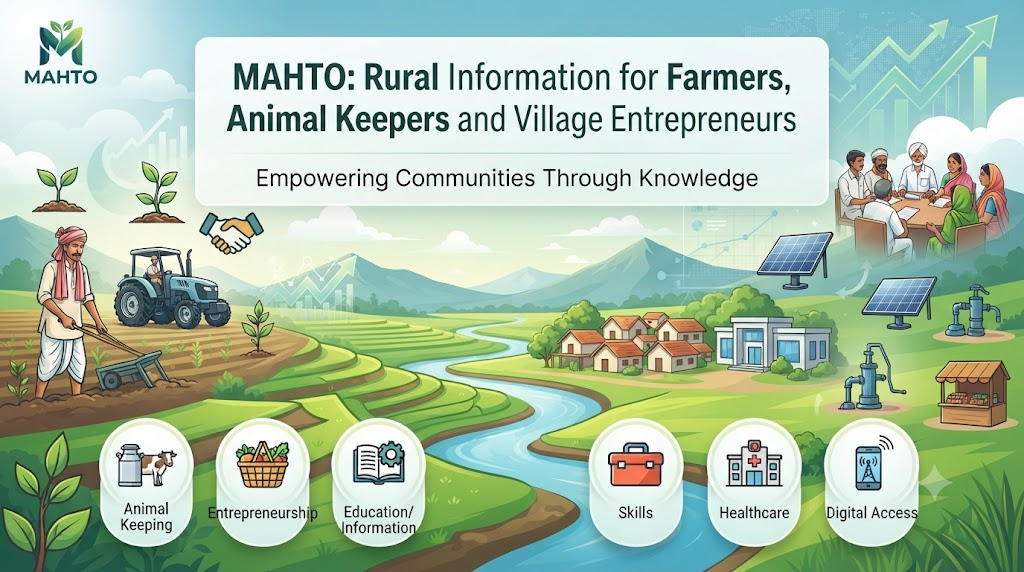
MAHTO is a rural knowledge platform that covers these connected subjects. It deals with agriculture, farmer schemes, livestock, mandi prices, weather guidance and village business opportunities. This article looks at the platform’s coverage from the point of view of three kinds of readers, and explains what each should check before acting.
What Is MAHTO?
MAHTO is a Hindi-first platform for Indian farmers, agricultural families, rural entrepreneurs and village communities. It aims to present useful topics in simple language, so that readers are not held back by complicated official or technical wording.
Its coverage includes:
- Crop guidance, irrigation, soil testing, fertilizers, pest control and crop calendars
- Farmer scheme topics such as PM-Kisan, PM Fasal Bima Yojana, Kisan Credit Card, Soil Health Card and state-level schemes
- Livestock topics including dairy, poultry, fish and goat farming, vaccination and animal nutrition
- Mandi-price information and village business ideas
Simple language matters because a reader who cannot follow a page is less likely to act on it. The subjects are also tied to each other in daily life. What is grown affects income, income affects borrowing, and animals or a small business can give a household another source of earning.
Why Reliable Rural Information Matters
Farming and rural work carry real risk. A late application, a poorly timed sale or an unplanned animal purchase can set a family back for months.
Reliable information helps in practical ways. It tells readers what a scheme asks for, how a market rate is reported, what animals need and what a new activity may cost. Because rules and prices change, it also reminds readers to confirm current details and to consider their own soil, water, climate and market.
Information for Different Rural Readers
For the Farmer Planning the Next Crop
Making Use of Local-Language Crop Notes
Good farming information in Hindi can explain crop selection, soil preparation, irrigation, fertilizer use, pest control, seasonal planning and harvest preparation in words that farmers use daily. Weather guidance can also help in timing sowing, irrigation and field work.
What suits one field may not suit another. Crop variety, soil, weather and local conditions all matter, so general notes should be checked with the local agriculture office.
Finding the Right Benefit
There are many government schemes for farmers, and they serve different purposes, such as income support, crop insurance, credit and soil health. For each one, find out who is eligible, what is offered, which documents are needed, how to apply and how to track the application.
PM-Kisan, PM Fasal Bima Yojana, Kisan Credit Card, Soil Health Card and state programmes have their own conditions. Not every scheme applies to every farmer, so each one should be checked separately against official information.
Keeping Beneficiary Records Correct
PM Kisan eKYC is the identity verification step connected with the PM-Kisan scheme. It exists so that the benefit reaches the correct, verified beneficiary.
Rules, dates and portal features can change, so readers should follow only current official instructions. Reviewing your own beneficiary details in advance can prevent delays, and a common service centre or the agriculture office can help with the process.
Working Out Whether Farm Credit Is Needed
The Kisan Credit Card is meant to help eligible farmers access credit for farming needs. Before applying, find out the current eligibility rules, required documents, interest conditions and the banks that offer it.
The bank decides on approval and the credit limit, so neither can be promised. Borrow only after understanding how and when repayment is due.
Planning a Paddy Season
Readers who want to know how to grow paddy can follow the crop through its stages. A variety is chosen to suit the region, season and water supply. The field is prepared and levelled. Where transplanting is used, seedlings are raised in a nursery and moved to the field later, whereas direct sowing places seed straight into it. Water and nutrients are managed through the growth period, fields are watched for weeds and pests, and harvest is planned for the right maturity.
Timing, water use and methods change with region, soil, climate and variety, so a method that works in one district should not be copied blindly into another.
Trying Organic Methods Gradually
Farmers interested in how to start organic farming usually begin with soil health. Compost, sensible crop rotation, careful pest management and reduced use of synthetic inputs, where suitable, are the main ideas.
Changing one plot at a time, with local guidance, tends to be more manageable than converting the whole farm. If produce will be sold as certified organic, certification requirements should be studied early. Organic farming is not automatically cheaper or more profitable, so costs and buyers need review.
For the Family Keeping Animals
Looking After the Herd or Flock
Sound livestock farming information focuses on balanced feed, clean water, clean and airy housing, vaccination, disease prevention, breeding management and regular veterinary care. These basics apply to dairy animals, poultry, fish and goats alike.
When an animal looks unwell, a qualified veterinarian should be called. Treatment based on unchecked advice may do harm. Simple written records of feeding, vaccination and health make it easier to notice changes.
Planning a Goat Unit
People asking how to start goat farming should start with a plan. Decide the purpose, whether meat, milk or breeding, and the number of animals you can manage. Look at breeds suited to the local climate, and prepare dry, clean housing with regular feed and fresh water. Arrange veterinary support for vaccination and disease prevention, and keep records of breeding and health.
Estimate the starting cost and monthly expenses, and check that there is local demand. Goat farming does not promise a fixed income, since results depend on care, animal health and market conditions.
For the Seller and the Small Entrepreneur
Comparing Markets Before a Sale
Anyone wondering how to check mandi prices should remember that a rate has meaning only with its details: the crop and variety, the market, the date, the quality grade and the unit of sale.
Rates differ between markets because of supply, demand, transport costs and quality, and they change over time. Treat a figure as a guide and confirm it from a recent source before choosing when and where to sell.
Weighing Local Business Options
Village business ideas often include dairy activities, poultry, goat rearing, food processing, local services and support work for farmers. Whatever the choice, ask whether people nearby will buy the product or service, how much money is needed, which skills are available, what the monthly costs will be and what could go wrong.
| Factor | Question to ask | Why it matters |
|---|---|---|
| Demand | Who will buy this, and how often? | Without buyers, output cannot become income |
| Investment | How much is needed to start? | Sets the amount at risk |
| Skills | Can we do the work well? | Weak skills raise costs and errors |
| Running costs | What is spent each month? | Shows whether the activity can sustain itself |
| Risks | What could go wrong? | Helps in planning for slow months |
Earnings cannot be guaranteed. A small beginning with a written estimate is safer than a large investment made on assumptions.
For Everyone: Preparing Questions for Advisers
Knowledge is most useful when it prepares you for a conversation. Before meeting an agricultural officer, a bank officer, an extension worker or a veterinarian, write down your questions and list the documents you may need. These people can verify current rules and advise on your land, animals and plans.
Five Moves for Careful Decision-Making
- Decide exactly what you need to find out.
- Gather recent information from reliable sources.
- Compare it with official requirements or local advice.
- Weigh the options, their costs and their risks.
- Speak with a qualified local adviser before committing.
Slips That Are Easy to Prevent
With schemes and papers
- Relying on scheme details that may have changed.
- Submitting an application with a document missing.
In the field and the market
- Using one farming method for every region and soil.
- Accepting a mandi rate without its date, market and unit.
With animals and business
- Buying animals before planning feed, housing and care.
- Expecting a new venture to earn from the first month.
- Treating animal illness with advice no veterinarian has reviewed.
Hypothetical Example: Selling Raw Produce or Starting Small Processing
A farming family has a regular surplus of one crop and wonders whether to keep selling it raw or begin a small processing activity. They first check recent rates for the raw produce in the nearest market. Then they ask local shopkeepers whether people buy a processed form of the same item and at what scale. They list the equipment, space and skills they would need, and estimate the monthly costs. Comparing the two options side by side, they decide to try a small trial batch before spending on equipment.
Questions Readers Often Raise
What is the difference between general information and official confirmation?
General information helps you understand a topic. Official confirmation tells you the current rule or requirement that applies to you, so important details should always be checked with the relevant office.
Can one family apply for more than one scheme?
That depends on the conditions of each scheme. Check every scheme separately and confirm with the official source or local office.
How do seasons and weather affect paddy planning?
Rainfall, water availability and variety influence when and how the crop is planted. Local weather guidance and agricultural advice help in choosing timing.
What should a beginner check before buying goats?
Ask a veterinarian or livestock officer to look at the animals’ health, and confirm that feed, housing and clean water are ready before the animals arrive.
How can a small producer decide whether processing is worth trying?
Check demand for the processed product, the equipment and skills needed and the running costs. A small trial is safer than a large first investment.
How can weather information help in farm planning?
It can guide choices such as irrigation, sowing and field work timing. Use forecasts for your own area and combine them with local advice.
Conclusion
Crops, credit, animals and local business are separate topics, but a rural household lives with all of them at once. MAHTO places them side by side in simple language, so that a reader can see how one decision affects another. The final choices, however, are best made after checking current details with officials, banks and veterinarians who know the local situation.
Leave a Reply