Practical SRE Thinking for Distributed and Cloud-Native Applications

September 21, 2026 · 15 reads
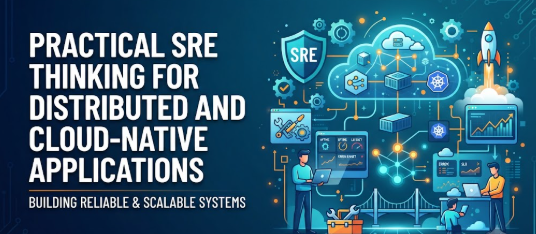
Modern software systems run around the clock. When a user opens an app or visits a website, they expect it to load instantly and work without errors. Behind the screen, however, keeping digital services online requires careful planning, constant observation, and smart engineering.
This work belongs to Site Reliability Engineering, a discipline that blends software writing with IT operations. Platforms like SRESchool.com help engineers and companies learn these vital production skills. This guide explores how reliability engineering works, why production systems fail, and how professional training helps teams build stable cloud environments.
What Is SRESchool.com?
SRESchool.com is a global learning and professional services platform focused entirely on Site Reliability Engineering. It helps people and companies learn how to build production systems that stay online, scale smoothly, and handle heavy traffic without crashing.
The platform offers several ways to build these skills:
- SRESchool.com Learning Areas: Focuses on practical topics like measuring uptime, tracking system health, reducing manual tasks, and planning for user growth.
- Professional Guidance: Provides structured learning paths for engineers, architects, and technical leaders.
- Organizational Support: Offers consulting and ongoing reliability services to help companies improve their cloud infrastructure.
By focusing on real-world reliability challenges, the platform helps technical teams move away from constant firefighting toward structured system design.
What Is Site Reliability Engineering?
Site Reliability Engineering started when organizations realized that traditional IT operations could not keep up with rapid software updates. Software developers want to release new features quickly, while operations teams want stable systems. SRE bridges this gap by applying software engineering solutions to operational problems.
Instead of manually fixing broken servers, reliability engineers write code to manage infrastructure, automate recovery, and monitor system health. Key areas include availability, performance, scalability, and disaster recovery.
For example, if an online store experiences a sudden surge in traffic during a holiday sale, an SRE approach ensures the system scales up automatically instead of crashing under the load.
Why Reliability Matters in Modern Systems
Production systems today are complex. They rely on cloud providers, distributed databases, third-party APIs, and microservices. When one small piece fails, the entire application can go offline.
Unplanned downtime leads to lost revenue, frustrated users, and damaged brand trust. Fixing these issues after they happen is expensive and stressful. Reliability should be planned from the beginning.
Teams that focus on reliability design their systems to handle partial failures gracefully. If a database slows down, a reliable system should show a friendly message or cache recent data instead of crashing completely.
SRESchool.com SRE Training
Learning how to keep systems online requires practical knowledge. SRE Training covers the core principles needed to manage complex production environments safely.
Good training teaches engineers how to measure system health, set clear goals, and respond to failures calmly. Learners study how to trace requests across distributed networks, design better alert systems, and remove repetitive manual work.
After completing training, engineers should understand how to find the root cause of a system failure instead of just restarting a server and hoping for the best.
SRE Certification and Knowledge Validation
Many professionals look for structured ways to prove their knowledge. An SRE Certification provides a clear path through complex reliability topics.
A good certification program tests an engineer’s understanding of monitoring, incident response, automation, and production engineering. However, passing an exam is not the same as having real-world experience. Certification validates that an engineer understands the core concepts, but true skill comes from managing live systems through actual failures.
Site Reliability Engineering Course Structure
A complete Site Reliability Engineering Course follows a logical learning path. It starts with the basics and moves toward advanced production management.
- Fundamentals: Understanding the core goals of reliability and how it bridges development and operations.
- Measurement: Learning how to track system health using indicators and objectives.
- Monitoring and Observability: Setting up logs, metrics, and traces to see inside running applications.
- Incident Management: Learning how to detect, triage, and resolve production outages quickly.
- Automation: Writing scripts and tools to handle repetitive tasks and routine recoveries.
- Postmortems: Reviewing past failures honestly to prevent them from happening again.
Becoming a Certified Site Reliability Engineer
Working toward becoming a Certified Site Reliability Engineer involves deep study of distributed systems and cloud infrastructure.
Certified professionals know how to balance the speed of software releases with the safety of production environments. They use data to make decisions about capacity and system limits. They also know how to lead incident response teams during major outages, keeping communication clear and focused on recovery.
SRE Consulting for Organizations
Sometimes internal teams need an outside perspective to improve their systems. SRE Consulting helps companies evaluate their current reliability maturity.
Consultants review existing monitoring setups, check alert rules, and help design realistic reliability goals. They look for bottlenecks in deployment pipelines and suggest ways to reduce manual operational work. This guidance helps organizations build a stronger engineering culture without disrupting daily development work.
SRE as a Service
Not every company can hire a full team of dedicated reliability engineers right away. SRE as a Service provides ongoing reliability support from outside experts.
Unlike one-time consulting, this service involves continuous monitoring, ongoing infrastructure improvements, and direct support during critical incidents. It gives growing companies access to senior reliability expertise while their internal developers focus on building product features.
Corporate SRE Training
Enterprise environments have unique challenges, such as legacy systems, strict compliance rules, and large cross-functional teams. Corporate SRE Training helps align entire engineering departments around common reliability standards.
Customized team training ensures that developers, system administrators, and managers speak the same language when discussing system health, risk, and deployment safety.
SRE Tutorial and Step-by-Step Learning
An SRE Tutorial offers practical, bite-sized lessons on specific reliability tasks. Tutorials help beginners understand how to configure a monitoring tool, write a basic SLO, or structure an incident review. Step-by-step guides make complex architectural ideas much easier to grasp.
Essential SRE Tools
Tools do not create reliability on their own, but the right technology makes managing complex systems much easier.
- Monitoring and Metrics: Tools like Prometheus collect numerical data about CPU usage, memory, and request rates to show overall system load.
- Logging: Tools like ELK stack capture detailed text records of application events, helping engineers trace exact error messages.
- Tracing: Distributed tracing tools track a single user request as it moves across dozens of different microservices.
- Incident Management: PagerDuty and similar platforms route alerts to the right on-call engineer and track incident timelines.
Understanding SLI, SLO, SLA, and Error Budget
Reliability cannot be managed by guessing. Teams use specific measurements to track how well a service performs.
- SLI (Service-Level Indicator): A direct measurement of service performance, such as request latency or error rate.
- SLO (Service-Level Objective): The target reliability goal set by the team, such as keeping 99.9% of requests under 200 milliseconds.
- SLA (Service-Level Agreement): A formal business contract with customers that includes penalties if reliability falls below a certain level.
- Error Budget: The amount of unreliability a service is allowed to have within a specific period. If a team stays within its error budget, they can release new features quickly. If they run out of budget, they must pause new releases and focus entirely on fixing reliability issues.
Monitoring vs. Observability
Many teams confuse monitoring with observability, but they serve different purposes.
Monitoring tells you when a system is broken. It triggers an alert when CPU usage hits 90% or error rates spike.
Observability tells you why the system is broken. By combining metrics, logs, and traces, observability allows engineers to ask open-ended questions about internal system behavior and find unknown issues that simple alerts missed.
Incident Management and Postmortems
When a production system fails, a structured response is essential. The incident lifecycle moves from detection and alert to triage, investigation, recovery, and final review.
After an incident is resolved, teams conduct a postmortem. A good postmortem focuses on what happened and why, without assigning personal blame. The goal is to update system architecture, improve documentation, and add automated tests so the same failure never happens twice.
Automation and Toil Reduction
Manual operational work, often called toil, slows down engineering teams and causes human mistakes. Automation replaces repetitive tasks like server provisioning, certificate renewals, and routine deployments with reliable code scripts.
However, automation must be treated with care. Poorly tested automation scripts can spread a small configuration error across hundreds of servers in seconds. Every automated workflow needs proper testing and safety checks.
Practical SRE Learning Path
Building professional reliability skills takes time and structured practice.
- Learn Linux and Networking: Understand basic operating system commands, TCP/IP traffic, and DNS resolution.
- Study Cloud Infrastructure: Learn how virtual servers, storage buckets, and load balancers operate in cloud environments.
- Master Monitoring Basics: Learn how to collect system metrics and write useful log queries.
- Understand SLIs and SLOs: Practice defining realistic reliability targets for web applications.
- Explore Incident Response: Participate in on-call rotations and learn how to triage production alerts.
- Practice Automation: Write scripts to automate repetitive infrastructure tasks.
- Study Distributed Systems: Learn how network partitions and service dependencies cause partial failures.
- Analyze Past Failures: Read postmortems and learn how to design systems that recover automatically.
Who Can Benefit from SRESchool.com?
- Students and Beginners: People starting their tech careers who want to understand how production systems actually run.
- Software Engineers: Developers who want to write code that performs well under heavy enterprise traffic.
- DevOps and Cloud Engineers: Professionals looking to deepen their knowledge of monitoring, SLOs, and automated recovery.
- Platform Engineers: Specialists building internal developer platforms that need high availability and uptime.
- Engineering Leaders: Managers and directors looking to establish healthy reliability practices across their departments.
- Growing Organizations: Companies scaling up their infrastructure and needing structured guidance on reliability maturity.
Frequently Asked Questions
What is Site Reliability Engineering?
Site Reliability Engineering is a discipline that applies software engineering principles to IT operations, helping teams build scalable, observable, and highly reliable production systems.
What does SRE Training cover?
SRE Training covers core topics like defining SLOs, setting up observability tools, managing incidents, reducing manual toil, and automating infrastructure recovery.
What is the difference between an SLI and an SLO?
An SLI is the actual metric measured, such as request latency. An SLO is the target goal set for that metric, such as keeping latency under a specific threshold 99% of the time.
How does an error budget work?
An error budget represents the acceptable amount of downtime or failure for a service. It helps teams balance the speed of new software releases with overall system stability.
What is the purpose of an SRE certification?
An SRE certification validates an individual’s theoretical knowledge of reliability concepts, monitoring, incident response, and production engineering best practices.
Why are postmortems important?
Postmortems provide a blameless way to analyze past outages, understand root causes, and plan technical improvements to prevent the same failure from recurring.
What is the difference between monitoring and observability?
Monitoring tells you when a system is failing by watching preset alerts, while observability helps you investigate and understand complex internal states to find unknown problems.
When should a company use SRE consulting?
Companies use SRE consulting when they need an external assessment of their reliability maturity, monitoring coverage, incident response workflows, and SLO strategies.
What is the difference between consulting and SRE as a Service?
Consulting provides temporary guidance and roadmap planning, whereas SRE as a Service provides ongoing, continuous operational reliability support and monitoring.
How do SRE practices reduce burnout?
SRE practices reduce operational burnout by automating repetitive manual toil, improving alert quality to reduce false alarms, and establishing calm incident response workflows.
Conclusion
Site Reliability Engineering transforms how organizations build and manage digital products. By combining software engineering with operations, teams can release new features quickly while keeping production environments stable. Platforms like SRESchool.com provide the essential training, courses, and resources needed to master these professional skills. Focus on fundamentals, measure what matters, and treat reliability as an ongoing engineering commitment.
Leave a Reply