Preparing for Modern Operations Roles Through XOps Skill Development

September 15, 2026 · 25 reads
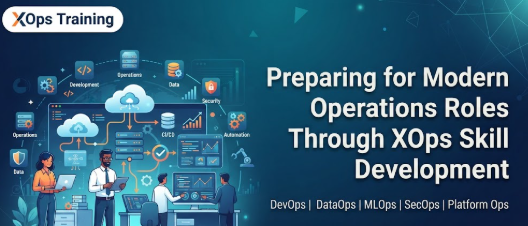
Technology teams today face a unique challenge. Building software is no longer just about writing code and deploying it to a simple server. Modern digital products rely on massive cloud infrastructure, complex data pipelines, machine learning models, artificial intelligence systems, security governance, and cost management. Because these areas often grow in silos, organizations frequently struggle with operational friction, communication gaps, and slow troubleshooting.
To solve these challenges, the technology industry has moved toward an integrated, umbrella approach known as XOps.
Platforms like XOpsSchool serve as a central learning and knowledge resource for professionals looking to understand how these diverse operational disciplines fit together. By organizing knowledge around training, courses, tutorials, and frameworks, such platforms help learners navigate the complex landscape of modern technology operations without treating every discipline as an isolated island.
What is XOps?
At its core, What is XOps is a question about connection and unification. The “X” in XOps acts as a variable representing various operational practices—such as DevOps, DataOps, MLOps, AIOps, SecOps, and FinOps. Rather than treating each operational methodology as a completely separate department or technology stack, XOps brings them together under a shared mindset of automation, reliability, continuous feedback, and collaboration.
In traditional IT environments, development teams threw code over the wall to operations, data engineers built pipelines without considering application delivery, and security was handled only at the final stage. XOps changes this by establishing shared practices across the entire lifecycle of digital systems. It emphasizes that applications, data, machine learning models, and infrastructure must share common principles: automation, monitoring, observability, and continuous delivery.
Why XOps Matters in Modern IT
As organizations adopt cloud-native architectures, microservices, and artificial intelligence, the sheer volume of operational data and moving parts increases exponentially. Disconnected processes create severe bottlenecks. For example, a high-performing application deployment can still fail if the underlying data pipeline breaks, or a machine-learning model can drift into irrelevance if it lacks ongoing operational monitoring.
XOps thinking encourages teams to adopt a unified operational strategy by promoting:
- Automation: Removing manual, error-prone tasks through infrastructure as code and automated workflows.
- Collaboration: Breaking down communication barriers between software developers, data scientists, infrastructure engineers, and security teams.
- Observability: Maintaining deep visibility into applications, data flows, infrastructure health, and system performance.
- Continuous Improvement: Using feedback loops to detect issues early, resolve incidents faster, and optimize resource usage.
Rather than viewing operations as a reactive chore, XOps treats operations as an engineering discipline that supports business agility and system reliability.
Major XOps Disciplines
XOps is composed of several key operational areas. Understanding these individual disciplines is essential before looking at how they connect.
DevOps
DevOps focuses on software delivery, bridging the gap between software development and IT operations. It relies heavily on continuous integration and continuous delivery (CI/CD), infrastructure automation, containerization, and configuration management to ship code safely and frequently.
DataOps
DataOps applies agile and automation principles to data engineering. It focuses on building reliable data pipelines, ensuring data quality, orchestrating complex data workflows, and monitoring data movement to ensure that analytics and applications receive accurate information.
MLOps
MLOps brings operational discipline to machine learning. It covers the end-to-end lifecycle of machine learning models—including model development, versioning, automated testing, deployment, and performance monitoring in production environments.
AIOps
AIOps uses artificial intelligence and machine learning technologies to enhance IT operations. By analyzing large volumes of log data, performance metrics, and alerts, AIOps tools can automate event correlation, detect anomalies, and help teams predict or resolve incidents faster.
SecOps
SecOps integrates security practices directly into operational workflows. Instead of treating security as an afterthought, SecOps ensures that vulnerability scanning, access control, and compliance checks happen continuously throughout the development and deployment lifecycle.
FinOps
FinOps addresses the financial accountability of cloud computing. It brings financial, technical, and business teams together to track, analyze, and optimize cloud infrastructure spending without sacrificing performance or speed.
Platform Engineering
Platform engineering focuses on building internal developer platforms. By providing self-service capabilities, reusable infrastructure templates, and standardized workflows, platform teams help software engineers deploy applications quickly and safely.
XOps Training
Building competence across these diverse areas requires structured learning. Effective XOps Training focuses on helping individuals understand not just single tools, but the underlying relationships between different operational domains.
A well-rounded training path typically guides learners through:
- Foundational software delivery and version control
- Cloud infrastructure and automation principles
- Container orchestration and Kubernetes fundamentals
- Observability, logging, and metrics collection
- Data pipelines and machine learning operations
- Security, governance, and reliability practices
Rather than focusing on memorizing software interfaces, proper training emphasizes architectural thinking, problem-solving, and operational efficiency.
XOps Certification
Technical certifications are popular tools for professionals seeking to validate their knowledge. An XOps Certification framework generally serves to help learners organize their study habits, follow a structured syllabus, and test their understanding of core concepts.
Preparing for a certification encourages professionals to fill knowledge gaps across cloud infrastructure, automation, and operational management. However, it is important to recognize that a certificate is a validation of foundational understanding, not an automatic substitute for hands-on practical experience. Real operational expertise is built by designing systems, troubleshooting failures, and working through real-world scenarios.
XOps Course
When looking for a structured learning program, choosing the right XOps Course is vital. A comprehensive course should take learners on a logical journey from basic concepts to advanced integration.
An ideal curriculum generally follows this progression:
- Introduction to XOps fundamentals and modern operational challenges
- Core DevOps principles and software delivery pipelines
- Cloud computing basics and infrastructure automation
- Containerization and cluster management
- Data operations and pipeline reliability
- Machine learning model deployment and lifecycle management
- AI-driven operations and monitoring techniques
- Observability, metrics, and incident management
- Security governance and cost optimization
- Integrating multiple operational practices into a cohesive workflow
Learners should select course depth based on their existing technical background, gradually expanding into unfamiliar domains.
XOps Tutorial
Practical understanding often comes from hands-on experimentation. An XOps Tutorial is valuable because it allows learners to apply theoretical knowledge to specific configurations and tasks.
Quality tutorials help users understand how to set up continuous integration pipelines, configure infrastructure automation, manage container deployments, establish monitoring dashboards, or build data workflows. While reading a tutorial provides the initial roadmap, true skill development happens when learners modify configurations, introduce intentional errors, and learn how to troubleshoot and fix them.
XOps Tools
XOps is not a single piece of software; therefore, XOps Tools span a wide range of categories depending on the specific operational requirement.
- Source Control: Git platforms for tracking code changes and collaboration.
- CI/CD: Jenkins, GitLab CI/CD, and GitHub Actions for automating build and deployment pipelines.
- Containers & Orchestration: Docker for containerization and Kubernetes for managing containerized workloads at scale.
- Infrastructure Automation: Terraform and Ansible for provisioning and configuring cloud resources.
- Observability: Prometheus, Grafana, and OpenTelemetry for monitoring system metrics, logs, and traces.
- GitOps: Argo CD and Flux for declarative, Git-driven infrastructure and application deployment.
- Data Operations: Specialized pipeline orchestration and data quality monitoring tools.
- MLOps & AIOps: Experiment tracking, model registries, and intelligent event correlation platforms.
Tool selection should always be driven by architectural requirements, team capabilities, security standards, and scalability needs rather than software popularity alone.
DevOps Training
Because DevOps is the bedrock of modern software delivery, DevOps Training forms a critical component of any broader operational learning path. It teaches engineers how to manage source code, automate testing, build reliable CI/CD pipelines, and manage infrastructure as code.
Understanding DevOps principles ensures that learners have a solid grasp of application packaging, containerization, and cloud deployment before attempting to tackle advanced data or machine learning operations.
AIOps Training
As system complexity grows, human operators alone cannot process the sheer volume of monitoring alerts. AIOps Training helps professionals understand how artificial intelligence and machine learning can assist in IT operations.
Learners study how automated log analysis, event correlation, and anomaly detection can reduce alert fatigue, surface hidden system issues, and assist incident responders. Importantly, training in this area also emphasizes the boundaries of AI, highlighting where human judgment and critical thinking remain indispensable during major outages.
MLOps Training
Deploying machine learning models into production requires specialized engineering practices. MLOps Training covers the model lifecycle, focusing on automated testing, model versioning, reproducibility, and continuous monitoring.
Learners explore how to prevent model drift, manage feature stores, and automate retraining pipelines, ensuring that data science initiatives translate into reliable, scalable software products.
DataOps Training
Data drives modern decision-making and artificial intelligence. DataOps Training focuses on establishing reliable data pipelines, data observability, and automated testing for data quality.
By applying software engineering rigor to data workflows, professionals learn how to prevent broken dashboards, incorrect analytics, and corrupted data inputs from reaching downstream applications.
How XOps Connects DevOps, DataOps, MLOps, and AIOps
To fully grasp the XOps philosophy, it helps to understand how its primary disciplines interact:
- DevOps ensures that application code moves smoothly from development to production.
- DataOps ensures that the data fueling those applications is clean, timely, and reliably transported.
- MLOps ensures that machine learning models are systematically deployed, monitored, and maintained.
- AIOps applies intelligence to monitor all of the above, detecting anomalies across applications, data, and infrastructure.
These disciplines share common operational foundations. They all rely on automation, version control, continuous monitoring, and feedback loops. XOps connects them by encouraging teams to look beyond their specific domain and consider how their work impacts the broader technological ecosystem.
XOps Disciplines at a Glance
| XOps Discipline | Main Focus | Common Learning Areas |
| DevOps | Software delivery and infrastructure automation | CI/CD, Containers, Kubernetes, Infrastructure as Code |
| DataOps | Reliable data movement and pipeline quality | Data pipelines, Data quality testing, Orchestration |
| MLOps | Machine learning lifecycle and model deployment | Model versioning, Experiment tracking, Monitoring |
| AIOps | Intelligent IT operations and alert correlation | Log analysis, Anomaly detection, Incident management |
| SecOps | Continuous security integration | Vulnerability scanning, Compliance, Access control |
| FinOps | Cloud cost management and optimization | Cost tracking, Resource allocation, Budgeting |
| Platform Engineering | Internal developer platforms and self-service | Developer portals, Reusable templates, Standardization |
Who Can Benefit from XOpsSchool?
1. DevOps and Cloud Engineers
Cloud and DevOps professionals can broaden their technical scope beyond application deployment, learning how infrastructure connects with data pipelines and machine learning workloads.
2. Data Engineers
Data engineers can use operational frameworks to improve data pipeline reliability, implement data observability, and apply software engineering best practices to data workflows.
3. Machine Learning Professionals
Data scientists and ML engineers can learn how to bridge the gap between experimental model creation and reliable, production-grade deployment and monitoring.
4. IT Operations and SRE Professionals
Site Reliability Engineers and traditional operations staff can integrate automation, observability, and AI-driven monitoring techniques to improve system reliability and incident response.
5. Developers and Technical Learners
Software developers can gain a deeper appreciation for the operational side of applications, understanding how code behaves in cloud-native production environments.
6. Technology Teams and Organizations
Engineering leaders and multidisciplinary teams can align their workflows around a shared operational framework, reducing silos and improving overall delivery speed.
Common Mistakes When Learning XOps
- Treating XOps as a Single Tool: Believing that purchasing or installing one software product achieves XOps maturity.
- Ignoring Fundamentals: Trying to learn advanced MLOps or AIOps without a basic understanding of Linux, networking, and DevOps.
- Spreading Too Thin: Attempting to master every single XOps discipline simultaneously instead of building competence step by step.
- Focusing Solely on Certification: Memorizing exam answers without engaging in hands-on practice or real-world projects.
- Neglecting Observability: Building complex deployment pipelines without setting up adequate logging, metrics, and tracing.
Best Practices for Learning XOps
- Start with Fundamentals: Build a strong grasp of Linux, version control, and basic networking before moving to cloud platforms.
- Master DevOps First: Understand CI/CD and containerization, as these form the foundational mechanics of all modern operations.
- Practice Infrastructure as Code: Learn how to provision and manage cloud resources programmatically rather than through manual clicks.
- Build Integrated Projects: Combine application code, a basic data workflow, and monitoring into a single personal project to see how components interact.
- Document Your Learning: Keep notes on configuration challenges, troubleshooting steps, and architectural decisions.
Recommended Learning Goals and Skills
| Learning Goal | Recommended XOps Area | Skills to Develop |
| Application delivery | DevOps | CI/CD pipelines, Docker, Kubernetes, Git |
| Cloud infrastructure | Cloud Engineering | Terraform, Ansible, Networking, IAM |
| Data pipelines | DataOps | Airflow, Data testing, Orchestration, Observability |
| Machine learning deployment | MLOps | Model serving, Experiment tracking, Version control |
| Intelligent monitoring | AIOps | Log aggregation, Alert management, Anomaly detection |
| Developer self-service | Platform Engineering | Internal portals, Template creation, Standardization |
| System reliability | SRE / Operations | SLIs, SLOs, Incident response, Monitoring |
8-Step XOps Learning Guide
- Understand What XOps Means: Learn the core philosophy of connected operational disciplines and why silos hinder modern technology teams.
- Build DevOps Foundations: Master version control with Git, containerization with Docker, and basic CI/CD pipeline creation.
- Learn Cloud and Infrastructure: Study cloud provider basics, networking fundamentals, and infrastructure automation using tools like Terraform.
- Learn Observability and Reliability: Understand how to collect metrics, logs, and traces, and establish Service Level Objectives (SLOs).
- Explore DataOps: Learn how reliable data pipelines, testing frameworks, and data orchestration function in modern architectures.
- Explore MLOps and AIOps: Understand model lifecycle management and how artificial intelligence assists in operational monitoring.
- Learn Security, Governance and Cost Awareness: Study continuous security practices (SecOps) and cloud financial management (FinOps).
- Build an Integrated Practical Project: Combine several operational areas into a single hands-on project to experience real-world integration.
Practical XOps Learning Approach
Moving from theory to practical capability requires active experimentation. Learners should set up local lab environments or cloud sandbox accounts to test configuration files, build CI/CD pipelines, deploy containerized applications, and configure monitoring dashboards. Simulating minor failures—such as breaking a configuration file or overloading a test service—and practicing the troubleshooting process builds the intuition required for real-world operational environments.
How to Choose XOps Tools
When evaluating technology for your operational stack, consider:
- Business and Technical Requirements: Does the tool solve a specific operational bottleneck?
- Team Skills: Can your team realistically learn, manage, and maintain the technology?
- Integration: How well does the tool fit with your existing infrastructure and CI/CD pipelines?
- Security and Compliance: Does the tool meet your organization’s security standards?
- Community and Support: Is the project actively maintained with strong community documentation?
Avoid adopting tools purely because they are trending; choose solutions that align with your team’s architectural maturity.
XOps Career and Skill Development
Developing knowledge across multiple operational disciplines makes technical professionals more versatile. Whether your primary role is software development, cloud administration, data engineering, or security, understanding XOps principles helps you communicate effectively across departments and design more resilient systems. Career growth in modern IT operations is driven by practical problem-solving ability, adaptability, and a strong foundational understanding of how technology systems operate end-to-end.
Using XOpsSchool as a Learning Resource
Platforms like XOpsSchool provide structured pathways for exploring modern IT operations. Learners can approach the platform by starting with core definitions, identifying the operational discipline most relevant to their current role, and using tutorials and courses to deepen their technical knowledge. By combining structured study with hands-on practice, professionals can steadily build a comprehensive understanding of connected operations.
Frequently Asked Questions (FAQs)
1. What is XOps in simple terms?
XOps is an umbrella approach that connects different operational disciplines—such as DevOps, DataOps, MLOps, and SecOps—under a shared culture of automation, observability, and collaboration.
2. How is XOps different from DevOps?
DevOps primarily focuses on software delivery and infrastructure automation, whereas XOps expands that collaborative mindset to include data, machine learning, AI, security, and cost management.
3. What disciplines are included in XOps?
Common disciplines include DevOps, DataOps, MLOps, AIOps, SecOps, FinOps, and Platform Engineering.
4. Is XOps suitable for beginners?
While advanced topics like MLOps require technical background, beginners can easily start with basic DevOps principles, cloud concepts, and XOps fundamentals.
5. What should an XOps training path include?
A solid training path should cover version control, CI/CD, cloud infrastructure, containerization, observability, and introductory data or machine learning operations.
6. What is the purpose of XOps certification?
Certifications help structure learning goals, validate foundational knowledge, and guide professionals through a comprehensive syllabus of technical concepts.
7. What should learners look for in an XOps course?
Look for courses that emphasize practical architecture, real-world operational challenges, and the relationships between different operational domains rather than just software syntax.
8. Which tools are commonly associated with XOps?
Common tools include Git, Docker, Kubernetes, Terraform, Prometheus, Grafana, Jenkins, and GitHub Actions, among others.
9. How are DevOps, DataOps, MLOps, and AIOps connected?
They all share core engineering principles like automation, version control, and monitoring, working together to support applications, data pipelines, and intelligent models.
10. How can someone start learning XOps?
Start by understanding basic DevOps foundations and cloud infrastructure, then gradually explore observability, data workflows, and integrated automation through hands-on practice.
Conclusion
Modern technology operations require more than isolated technical skills. As software, data, artificial intelligence, and cloud infrastructure converge, teams need a unified approach to maintain reliability and speed. XOps provides that framework, connecting DevOps, DataOps, MLOps, AIOps, and other disciplines through shared automation and observability principles. By utilizing structured learning resources like XOpsSchool, professionals can navigate this evolving landscape, bridge operational silos, and build resilient, future-ready technology systems.
Leave a Reply