The Definitive Architecture of Artificial Intelligence for IT Operations

September 18, 2026 · 32 reads
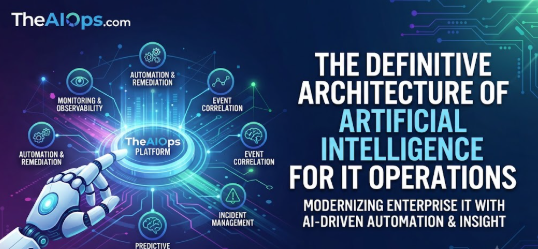
Modern digital infrastructure operates at a scale and complexity that far exceeds human cognitive limits. Enterprise environments distribute workloads across multi-cloud clusters, microservices meshes, and containerized nodes, generating millions of telemetry events every second. Traditional monitoring tools, which rely on static thresholds and threshold-based alert triggers, fail in these dynamic environments because they create an overwhelming volume of false positives and alert fatigue.
Artificial Intelligence for IT Operations solves this architectural bottleneck by merging big data ingestion, machine learning algorithms, and automated orchestration into a unified control plane. Organizations moving away from reactive firefighting toward predictive reliability depend on advanced telemetry parsing, root-cause isolation, and closed-loop remediation workflows to maintain high service availability.
What Is Artificial Intelligence for IT Operations
Artificial Intelligence for IT Operations represents an advanced discipline within enterprise systems management that integrates machine learning models, statistical pattern recognition, and natural language processing into operational data streams. Rather than waiting for system administrators to manually interpret log files or CPU spikes, algorithmic models ingest continuous telemetry from disparate sources, including infrastructure logs, performance metrics, network traces, and incident management tickets.
The foundational engine behind these capabilities relies on unsupervised and supervised machine learning pipelines. Unsupervised algorithms establish dynamic behavioral baselines by observing normal system states over extended periods, allowing the system to detect anomalous deviations without requiring predefined signature rules. Supervised models leverage historical incident data to classify failure types and recommend corrective actions based on past resolution patterns.
- Continuous Metric Ingestion: Aggregates time-series data, operational metrics, and event logs from diverse hybrid-cloud environments into a centralized data lake.
- Dynamic Baseline Modeling: Continuously adapts normal performance thresholds based on shifting traffic patterns, seasonal usage spikes, and software deployments.
- Multidimensional Anomaly Detection: Identifies subtle, non-linear correlations across disparate system layers that single-metric monitors routinely overlook.
- Automated Noise Suppression: Filters out redundant and cascading alert triggers, presenting engineers with consolidated incident views rather than fragmented notifications.
Why Intelligent Operations Matter Today
The financial and operational cost of unplanned downtime makes traditional reactive management unsustainable. When critical web applications, payment gateways, or enterprise databases fail, organizations face immediate revenue loss, regulatory penalties, and long-term brand erosion. Engineering teams trapped in a cycle of constant alert triage suffer from burnout, delayed feature releases, and extended Mean Time to Resolution.
Intelligent operations matter because they fundamentally transform the economics of infrastructure management. By shifting focus from manual alert monitoring to automated pattern recognition, companies achieve higher system resilience and operational efficiency. Intelligent systems correlate symptoms across the entire technology stack, isolating underlying software bugs or hardware degradation before user-facing performance degrades.
- Downtime Mitigation: Prevents catastrophic system failures by identifying early-stage resource exhaustion and memory leaks.
- Resource Optimization: Lowers infrastructure overhead by right-sizing server capacity and eliminating redundant monitoring scripts.
- Engineering Velocity: Reallocates developer and administrator hours away from routine firefighting toward strategic feature development.
- Unified Visibility: Eliminates operational silos between development, security, and infrastructure teams by providing a single source of operational truth.
Exploring TheAIOps.com as Your Central Learning and Consulting Hub
Navigating the transition toward intelligent automation requires access to structured knowledge resources, expert advisory frameworks, and comprehensive software evaluation criteria. Platforms like TheAIOps.com serve as specialized learning and consulting ecosystems designed to guide professionals and enterprises through every phase of operational transformation.
Organizations evaluating digital maturity models leverage specialized resources to bridge the gap between theoretical machine learning concepts and practical production deployments. Whether an enterprise seeks foundational training for its engineering staff or strategic consulting for multi-cloud automation rollouts, centralized knowledge platforms provide the necessary roadmap.
| Operational Resource Domain | Primary Functional Focus | Target Audience |
| Educational Pathways | Core concepts, architecture patterns, and practical execution | System administrators and rising engineers |
| Strategic Advisory | Environment assessment, feasibility studies, and custom roadmaps | Enterprise architects and IT leadership |
| Platform Evaluation | Tool comparisons, feature analysis, and integration guidelines | Procurement teams and DevOps directors |
Mastering Skills Through Professional Education Programs
Building internal competency in automated systems management requires rigorous, structured learning pathways that bridge theoretical concepts with hands-on technical execution.
AIOps Training for Practical Technical Skills
Structured training initiatives equip practitioners with the competencies needed to design, deploy, and maintain intelligent monitoring pipelines. Learners explore how data streams from edge servers into centralized analytics engines.
- Intelligent Telemetry Monitoring: Mastering the collection and parsing of multi-source performance logs.
- Advanced Anomaly Detection: Configuring algorithms to recognize complex performance outliers.
- Cross-Domain Event Correlation: Connecting network, application, and database alerts into singular root-cause incidents.
- Automated Remediation Scripting: Writing self-healing workflows using Python and orchestration tools.
Validating Expertise With AIOps Certification
Professional certification programs provide formal validation of an engineer’s technical proficiency in automated operations management. These examinations test practical problem-solving skills across real-world operational failure scenarios.
- Industry Credibility: Proves deep technical comprehension of machine learning applications in IT management.
- Career Advancement: Positions certified engineers for leadership roles in enterprise reliability engineering.
- Employer Confidence: Assures organizational leadership that technical staff can safely manage autonomous systems.
- Commitment to Excellence: Promotes ongoing professional growth in rapidly evolving technical landscapes.
Deep-Dive Learning Through an AIOps Course
Comprehensive educational courses deliver structured curriculums covering foundational architecture, machine learning models, deployment strategies, and organizational change management.
- Modular Architecture Breakdown: Explores data pipelines, ingestion brokers, and analytics engines in detail.
- Real-World Case Studies: Analyzes enterprise transformations and lessons learned from large-scale deployments.
- Hands-On Laboratories: Provides practical experience configuring monitoring dashboards and automated playbooks.
- Strategic Scaling Guides: Teaches methods for expanding automation across hybrid enterprise infrastructures.
Expert Advisory and Professional Services for Organizations
Adopting intelligent automation across legacy enterprise environments demands careful planning, risk assessment, and precise architectural integration.
Leveraging AIOps Consulting for Strategic Roadmaps
Consulting engagements help organizations evaluate their current operational maturity, identify automation bottlenecks, and build comprehensive multi-phase adoption roadmaps.
- Environment Auditing: Reviews existing monitoring tools, loggers, and ticketing systems to identify capability gaps.
- Readiness Assessment: Determines whether infrastructure data quality meets the prerequisites for machine learning ingestion.
- Roadmap Development: Establishes clear, milestone-driven timelines for tool procurement and phased rollouts.
- Risk Mitigation: Identifies potential security vulnerabilities and compliance hurdles before deployment begins.
Deploying AIOps Services for Seamless Integration
Professional services teams assist with the technical execution of connecting intelligent platforms into existing enterprise toolchains, ensuring smooth data flow and minimal disruption.
- Pipeline Integration: Connects monitoring feeds directly into machine learning analytics engines without data loss.
- Workflow Automation: Integrates incident management tools with automated remediation playbooks.
- Custom Model Tuning: Adjusts anomaly detection sensitivity to match specific application workloads.
- Performance Optimization: Continuously monitors system health to lower operational latency and resource consumption.
Evaluating Tools and Platforms for Modern Infrastructure
Selecting the appropriate software ecosystem is a critical decision that influences long-term infrastructure stability and team productivity.
Navigating the Landscape of AIOps Tools
Enterprise operations tools must ingest massive data volumes with minimal latency, utilizing robust analytical filters to separate actionable insights from background noise.
| Platform Feature Category | Core Operational Function | Direct Enterprise Advantage |
| High-Speed Ingestion | Processes high-volume log streams in real time | Complete, uncompromised system observability |
| Algorithmic Noise Reduction | Suppresses duplicate warnings and alert storms | Dramatically reduced operator cognitive fatigue |
| Predictive Failure Modeling | Forecasts hardware and software degradation | Zero-downtime proactive maintenance scheduling |
Selecting the Right AIOps Platform for Your Team
Organizations must evaluate software platforms against their specific technical requirements, cloud architecture, and organizational scale.
- Ecosystem Compatibility: Verify native integration support for existing cloud providers and container orchestration tools.
- User Interface Usability: Ensure dashboards present complex analytical data with high clarity and intuitive navigation.
- Scalability Metrics: Confirm the platform handles peak enterprise traffic loads without performance degradation.
- Community and Vendor Support: Review documentation quality, update frequency, and enterprise support responsiveness.
Step-by-Step AIOps Implementation Strategies
Transitioning from traditional reactive monitoring to an automated operational model requires a disciplined, phased execution strategy.
Practical Rollout Roadmap
A structured implementation roadmap prevents system instability and ensures engineering teams adapt effectively to new automated workflows.
- Discovery and Audit Phase: Catalog all active monitoring tools, data sources, and incident management workflows across the enterprise.
- Pilot Testing Environment: Deploy intelligent analytics on a single non-critical application tier to evaluate model accuracy.
- Data Tuning and Threshold Calibration: Adjust machine learning sensitivity parameters to eliminate false alarms and calibrate baseline models.
- Gradual Production Rollout: Expand automated monitoring and remediation playbooks across primary enterprise services in controlled increments.
- Continuous Governance Review: Regularly audit system performance reports, refine automation rules, and update remediation scripts.
Career Growth and Roadmap for an AIOps Engineer
The demand for specialized engineers who understand both traditional systems administration and machine learning operations has expanded significantly across the technology sector.
Engineers typically transition into this discipline by building strong foundations in Linux systems, cloud computing, and infrastructure-as-code before advancing into data analytics and automation development.
- Core Infrastructure Mastery: Build deep expertise in Linux administration, containerization, and multi-cloud environments.
- Automation and Scripting: Learn modern scripting languages like Python or Go for orchestrating automated workflows.
- Data Analytics Fundamentals: Study statistical modeling, time-series analysis, and machine learning concepts.
- Reliability Engineering Practice: Gain practical experience in incident management, root-cause analysis, and system resilience design.
Key Benefits of Adopting Smart IT Solutions
Integrating artificial intelligence into daily operational workflows delivers measurable improvements across system reliability, cost efficiency, and team morale.
- Accelerated Incident Resolution: Automatically isolates root causes, drastically lowering Mean Time to Resolution.
- Enhanced Team Well-Being: Minimizes midnight alert fatigue, allowing engineers to maintain sustainable work-life balance.
- Elastic Scalability: Automatically manages high traffic spikes and complex workload fluctuations without manual intervention.
- Maximized ROI: Optimizes cloud resource allocation, reducing unnecessary infrastructure waste and operational expenditures.
Common Mistakes to Avoid During Transformation
Even with advanced technology investments, automation projects can falter if organizations commit avoidable strategic errors.
- Rushing Enterprise Rollout: Attempting full-scale automation across all systems on day one introduces severe operational risk.
- Neglecting Data Quality: Feeding unformatted, dirty, or incomplete log data into machine learning models yields inaccurate predictions.
- Failing to Train Staff: Deploying complex platforms without providing comprehensive education leads to low user adoption.
- Overlooking Security Controls: Neglecting to secure telemetry data pipelines creates dangerous vulnerabilities across the infrastructure.
Frequently Asked Questions
What does AIOps stand for in enterprise environments?
It stands for Artificial Intelligence for IT Operations, describing the application of big data and machine learning to automate infrastructure management tasks.
Do I need advanced data science degrees to start learning?
Advanced mathematical backgrounds help, but foundational training paths begin with practical operational concepts accessible to experienced system administrators.
How do intelligent platforms eliminate alert fatigue?
Algorithms analyze incoming event streams, group related alerts into singular incidents, and filter out repetitive background noise.
Can small and mid-sized businesses adopt automated monitoring?
Yes, scalable software platforms allow organizations of varying sizes to implement intelligent monitoring tailored to their infrastructure needs.
What is the typical duration for an initial implementation project?
Timelines vary based on environment complexity, but initial pilot projects typically launch and stabilize within several weeks.
What technical background supports a career as an operations engineer?
Experience in system administration, cloud architecture, DevOps practices, and basic scripting provides an ideal professional foundation.
Are intelligent monitoring platforms secure for sensitive corporate data?
Enterprise-grade platforms employ rigorous encryption standards, role-based access controls, and secure data pipelines to protect operational assets.
How do professional certifications impact career progression?
Certifications provide formal validation of technical competence, helping professionals demonstrate their expertise to prospective employers.
What distinguishes traditional monitoring from intelligent operations?
Traditional tools alert operators after a failure occurs, whereas intelligent platforms use predictive analytics to identify and prevent issues proactively.
Where can organizations find comprehensive guidance and consulting resources?
Specialized knowledge platforms provide structured training programs, architectural roadmaps, and professional advisory services to support successful deployments.
Conclusion
The evolution of modern digital infrastructure demands a transition toward intelligent, automated operations. By combining robust telemetry ingestion, structured professional education, advanced software tools, and disciplined implementation strategies, organizations achieve unprecedented levels of system reliability. Professionals and enterprises that cultivate expertise in this domain position themselves for long-term success in an increasingly complex digital ecosystem.
Leave a Reply